Congratulations to Mely Lerman. His new book, The AI Tsunami and the COBOL Ark, launches on 20 October 2026 as a Kindle eBook.[1] Lerman started in the industry in 1965 and has spent, in his words, sixty years on "software architecture, mainframe legacy systems, and insurance applications across Europe, the Middle East, Asia, and the Americas".[1] Very few authors can write about COBOL from that much first-hand experience.
We have not read the book yet. Everything we say about it below comes from the author's own launch post and from a review by an early reader, and we quote and link both. After that we look at the problem the book addresses, and at what CobolStack already offers people who want to do what it describes: use AI to learn and understand COBOL, and practise somewhere that is not production.
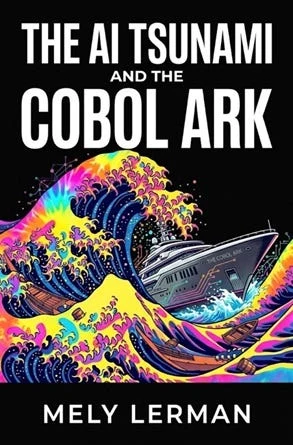
Book cover from the author's launch post. Source: Mely Lerman, "The AI Tsunami and the COBOL Ark: Launching in 6 Days", Substack, 14 October 2026.
What the book is about, in the author's words
Lerman's launch post describes the book as "a deep dive into COBOL, its history, and the reality of why it has survived for almost seventy years while thousands of newer technologies have vanished".[1] It asks why organisations keep trying to replace COBOL, and why "those massive, expensive modernization projects mostly fail". His answer is that cloud migrations and automated translation to Java or C# "ignore the sheer complexity and deterministic reliability of the original business logic".
The approach he puts forward is "modular, in-place software refactoring and local AI comprehension engines", which he calls "the only pragmatic paths forward".[1] He also promises stories from the field and "a distillation of what actually works, stripped of the industry hype". The post ends with a question: "Are we ready to stop fighting the systems that run the global economy and instead learn how to properly bring them into the AI era?"
The ideas come from his work. His speaker profile lists him as the founder of COBOL Toolkit, a tool for analysing legacy COBOL. At Codemotion Milan in October 2025 he gave a talk with the same title and the subtitle "Why Your Next Job Might Be 60 Years Old".[2]
What an early reader says
Georges Kopp, an IBM Champion, read an advance copy and reviewed it on LinkedIn. He describes the problem the book starts from: the engineers who maintain these systems are retiring, which leaves "decades of irreplaceable, complex business logic at risk". He then summarises the book's answer:[3]
Kopp calls it "a compelling blueprint for bridging the generational knowledge gap without abandoning the code that runs the global economy." The full review is on his LinkedIn post.
Why this matters now
COBOL still runs a lot of daily business. In 2017 a Reuters Graphics piece put COBOL in use at 220 billion lines. It said 43% of banking systems are built on COBOL and 95% of ATM swipes rely on COBOL code.[4] The accompanying Reuters report estimated that $3 trillion in daily commerce flows through COBOL systems.[5] These figures are now nine years old and were compiled from industry sources, so treat them as an order of magnitude. They are still the figures most often quoted.
The people problem is more recent. Kyndryl's 2025 survey of 500 business and IT leaders found that "70% of organizations are struggling to find the right multi-skilled talent needed" for mainframe modernization.[6]
Using AI to understand code is also no longer unusual. IBM's watsonx Code Assistant for Z offers to "create natural language explanations of code" and to help teams "understand mainframe code and document business logic faster".[7] In February 2026 Anthropic described a similar flow for COBOL, in which "AI starts by reading your entire COBOL codebase and mapping the structure".[8] The book's contribution, judging by its description, is to aim that capability at education: AI as the patient tutor that helps a newcomer read code nobody has explained to them.
That leaves one practical question. Where does the newcomer practise? Learning to read a production COBOL estate on the production system is how outages happen. Learning only from slides means you never see a job abend at 2 a.m. The rest of this post is about the space in between.
Where CobolStack fits
CobolStack builds training and practice environments for mainframe and IBM i skills. Lerman and Kopp have not reviewed or endorsed what follows. This is our own reading of how the tools we already run line up with the book's themes, as its author and reviewer describe them.
| Theme | What exists today |
|---|---|
| AI as a tutor | An assistant panel inside SteelFrame, beside the 3270 terminal. Ask it about the screen in front of you, or ask it to show you. With Show me on the terminal it works on your own terminal or VS Code tab and narrates each step as it goes. You choose between three Claude model tiers. It runs on AI credit, and every new user ID starts with a welcome credit. Your own typing is always free. |
| A comprehension engine that maps the code | The SteelFrame MCP server gives your own agent analysis tools: search_source, find_program, explain_program, inventory_scan and call/impact graphs. It can also run what it reads: decode_records shows a record through its copybook beside the raw EBCDIC and packed-decimal bytes. Anyone with a SteelFrame ID can create a scoped API key on their account page. |
| Untangling embedded rules safely | A sandbox, not production. AWS CardDemo, a realistic CICS/VSAM/batch application, runs from its own source on SteelFrame. An agent can work in a private workspace copy of the estate, so a wrong guess costs nothing. When you think you have found the rule, run the program and check what it actually does. |
| Educating a new generation | Self-paced courses on learn.cobolstack.com, each with a free plan. CS100 Mainframe Foundations starts with the architecture. CS105 COBOL On-Ramp starts by reading a production-shaped program before you write a line. Every lab is machine-checked against expected output. |
| In-place refactoring, or not | The COBOL compiles and runs as it is, so a change made in place can be checked against the original program's output, byte for byte. Some teams choose to move data or logic instead. For them, the VS Code (Zowe) tab adds Java, Python and a personal PostgreSQL database that can import DB2 tables and VSAM files with a parity check. |
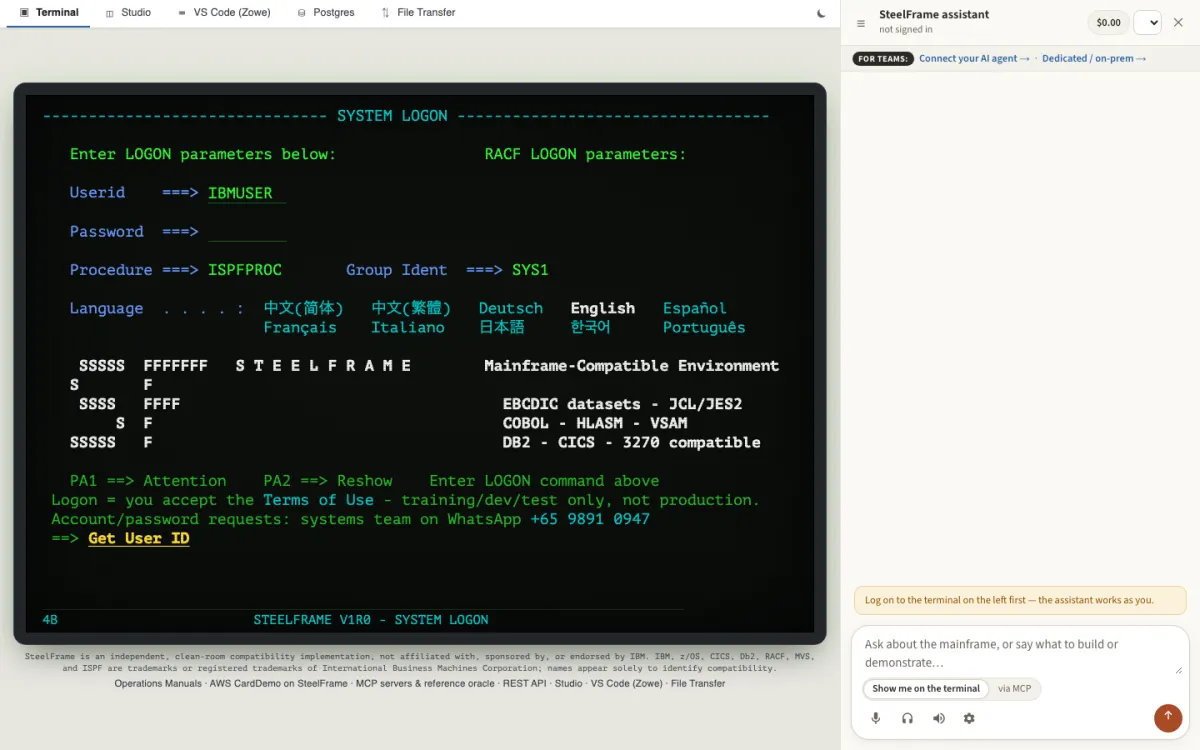
SteelFrame as a logged-out visitor sees it today: the 3270 logon on the left, the assistant panel on the right. Screenshot from steelframe.cobolstack.com, 15 October 2026.
Two honest differences
"Local" AI. The book's description talks about local comprehension engines, and Kopp's review says localized AI. Our built-in assistant is not local: it calls Anthropic's Claude models. For practice code such as CardDemo or course labs, that does not matter. For an organisation's own source, it may. In that case the MCP route lets a team bring an agent wired to a model they host themselves, and SteelFrame can run as a dedicated instance on the team's own cloud account or on its premises (see Environments). Then neither the code nor the model leaves the building.
Translation. Lerman is sceptical of automated translation to Java or C#. We teach conversion courses too, and we think the deciding question is whether you can prove the new code behaves like the old. That is why CS500 compares rehost, refactor, rewrite and replace side by side rather than assuming one answer, and why CS550 is subtitled "Verify, Don't Trust". On that last point, a reader of the book and a student of ours should find a lot of common ground.
What SteelFrame is, and is not
SteelFrame is an independent, clean-room, mainframe-compatible environment that runs in the browser: EBCDIC data sets, JCL with a JES2-class spool, COBOL, VSAM, a DB2-compatible SQL engine and CICS-style transactions. It is not IBM z/OS. It is for training, development and testing, not production. CobolStack is not affiliated with IBM, and our certificates are CobolStack certificates, not IBM certifications. For background, see our earlier posts: AWS CardDemo on SteelFrame and MCP on the Mainframe Already Runs.
Get the book, and try the ark
- The book: The AI Tsunami and the COBOL Ark by Mely Lerman, Kindle eBook, launching 20 October 2026. The author's Substack ↗ will post the link on launch day. He also asks readers to share their own experiences with legacy systems in the comments there.
- Practise: open SteelFrame ↗ and choose Get User ID. Registration is free.
- Learn: start with CS100 and CS105, or browse the catalog.
- Teams: talk to us about cohorts or a dedicated instance.
Congratulations again to Mely Lerman on the launch. We look forward to reading it.
Sources
- Mely Lerman, "The AI Tsunami and the COBOL Ark: Launching in 6 Days", Substack, 14 October 2026: launch date, Kindle eBook, the book's description, the author's career since 1965, and the cover image.
- Mely Lerman, speaker profile on Sessionize: founder of COBOL Toolkit; the session "The AI Tsunami and the COBOL Ark: Why Your Next Job Might Be 60 Years Old", Codemotion Milan 2025.
- Georges Kopp, review of an advance copy, LinkedIn, October 2026.
- Reuters Graphics (Travis Hartman), "COBOL blues", 2017: 220 billion lines in use, 43% of banking systems, 95% of ATM swipes. The graphic credits TIOBE Index, International Cobol Survey Report, IBM, Micro Focus, Celent and Accenture.
- Reuters (via CNBC), "Banks scramble to fix old systems as IT 'cowboys' ride into sunset", 11 April 2017: $3 trillion in daily commerce.
- Kyndryl, 2025 State of Mainframe Modernization survey, 9 September 2025: 500 business and IT leaders; 70% struggling to find the right multi-skilled talent.
- IBM, watsonx Code Assistant for Z, product page (checked 15 October 2026).
- Anthropic, "COBOL Modernization with AI: Breaking the Cost Barrier", 23 February 2026.
Descriptions of the book come only from the author's launch post and Georges Kopp's review; we have not read it. Quotations are short and linked to their sources. The cover image is the author's, from his Substack post, reproduced to announce and link to the book. External figures are as published by their sources on the dates shown. IBM, z/OS, CICS, Db2, VSAM and watsonx are trademarks of International Business Machines Corporation. Claude is a trademark of Anthropic. AWS and CardDemo are names of Amazon.com, Inc. or its affiliates. Kindle is a trademark of Amazon.com, Inc. or its affiliates. CobolStack is not affiliated with, endorsed by, or sponsored by IBM, Amazon, Mely Lerman or Georges Kopp. SteelFrame is an independent clean-room mainframe-compatible implementation, not IBM z/OS; your licensed system remains the sole conformance authority.